
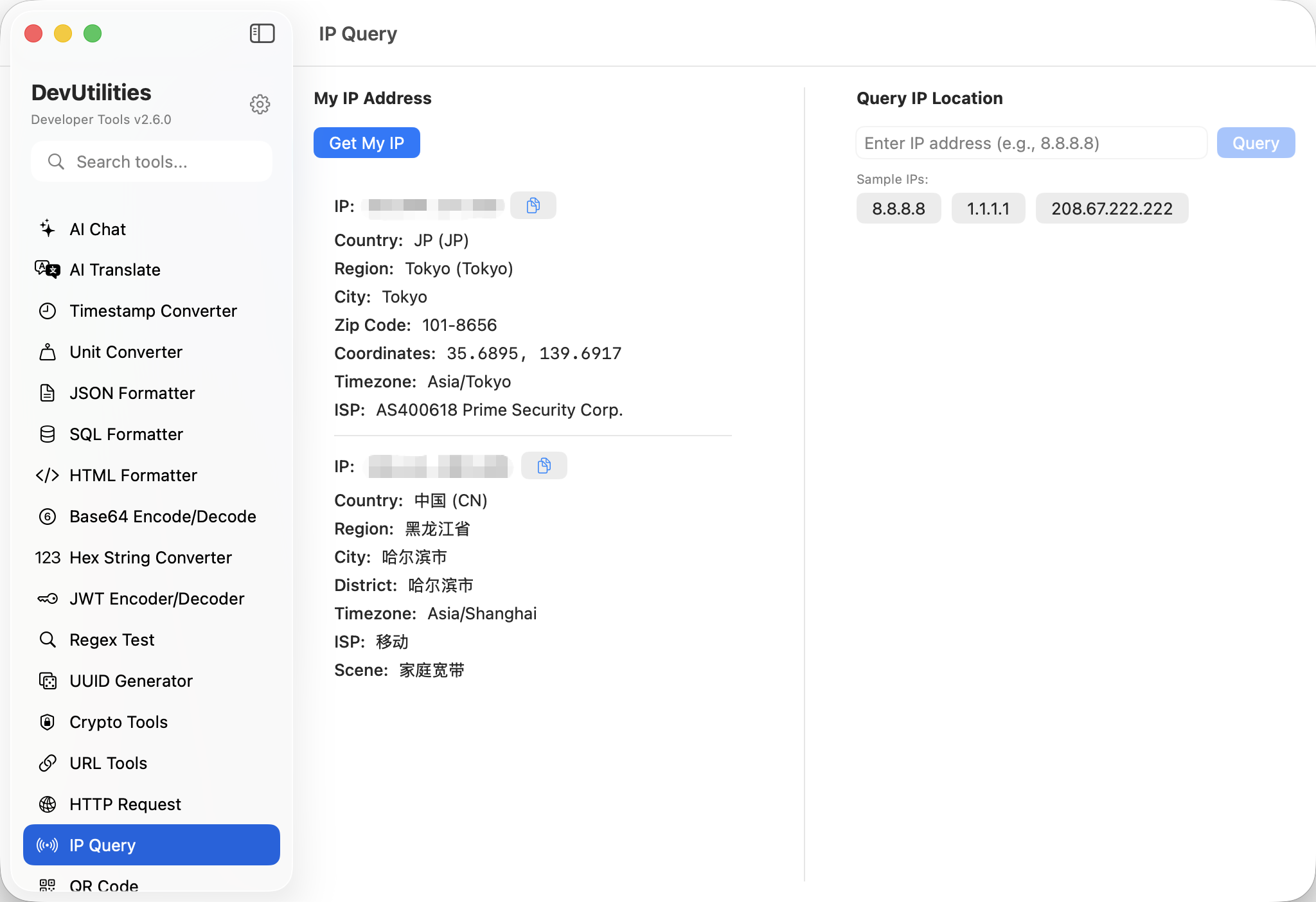
Six things it does well.
Your IP, both versions
IPv4 and IPv6 displayed when reachable. Useful for diagnosing dual-stack reachability.
Lookup any address
Type or paste any v4 / v6 address; the geolocation card fills in.
Two providers
ipinfo.io is the primary; ip.sb covers regions where ipinfo is rate-limited or blocked. Toggle visibly.
ASN & org
The autonomous-system number and the organisation it belongs to. Useful for hosting checks.
Timezone
The IP's local timezone, alongside city. Pair with Timestamp when reproducing user reports.
One-click copy
Copy any field individually; copy the whole card as JSON.
Four moves through an IP.
Open the panel
Your address shows immediately. Both v4 and v6 if both are reachable.
Look up another
Type or paste an IP. Geolocation card appears below.
Switch provider
If one provider is slow or rate-limited, switch — the other often answers immediately.
Copy
Per-field or whole card as JSON, ready to paste into a ticket.
The work it actually does.
Reproducing tickets
Look up a user's reported IP to confirm region; pair with Timestamp for time-of-day reproduction.
ASN identification
Spot hosting providers, CDNs, and ISPs by their autonomous-system numbers.
Suspicious traffic
Geolocate IPs from access logs to spot outliers in traffic patterns.
Dual-stack checks
Confirm both v4 and v6 reachability from your network.
VPN sanity
Check the address you're presenting to the internet matches what you expect.
Reproducible reports
Copy the whole geolocation card as JSON for inclusion in a bug report.
Things people ask before they download.
Which providers are used?
ipinfo.io as the primary; ip.sb as the alternative. Both are public APIs.
Is location accurate?
Country and region are reliable; city is best-effort. ASN / org are accurate by definition.
Does this work in China?
Yes — the alternate provider was added specifically to keep lookups reliable across regions where ipinfo.io may be blocked.
Is my IP logged?
Not by us — we have no servers. Whether the upstream provider logs is up to their privacy policy. See the privacy policy for the full picture.
IPv6 supported?
Yes. Both your own v6 (when reachable) and lookups for any v6 address.
What's exported?
Per-field copy, plus a "copy as JSON" for the whole card.