
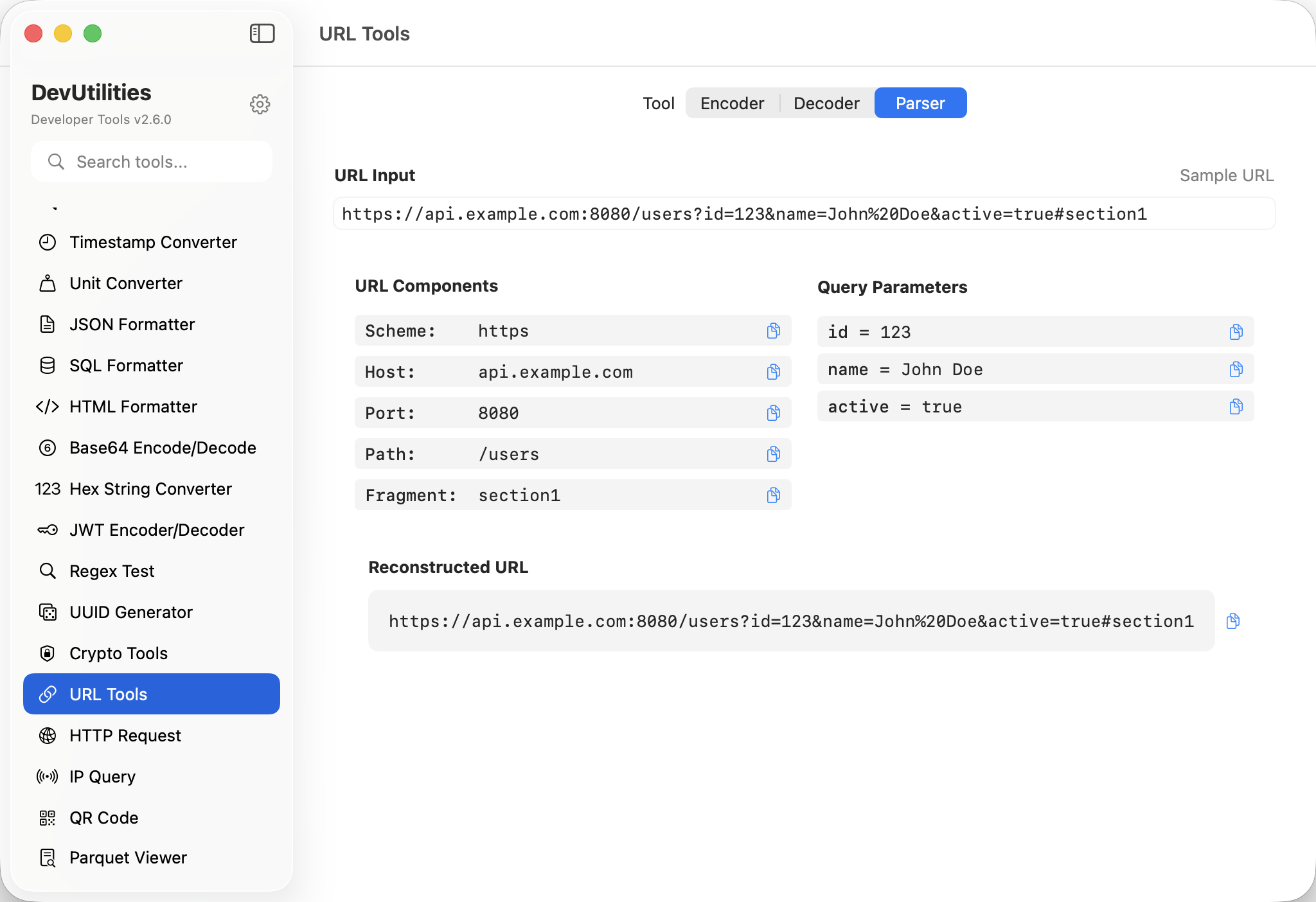
Six things it does well.
Encode & decode
Percent-encoding both directions. Pick whether to encode reserved characters; ideal for query values and path segments.
Parser breakdown
Scheme, user, host, port, path, query, fragment — all named, all editable.
Query string editor
The query renders as a list of key/value rows. Add, remove, edit; the URL rewrites itself.
IDN handling
Internationalised domain names round-trip cleanly between Unicode and ASCII (Punycode).
Validation
Invalid URLs surface a precise error pointing at the offending component.
One-click copy
Copy the encoded string, the decoded string, or the parsed structure as a list.
Four moves around a URL.
Paste
Drop the URL — encoded, decoded, or partial.
Inspect components
Scheme, host, path, query — each labelled and editable.
Tweak the query
Add or remove parameters in the list editor; the URL rewrites accordingly.
Copy result
Encoded for the wire, decoded for the eye, structure for the doc.
The work it actually does.
Building requests
Construct a tricky URL with several encoded query values without escape gymnastics.
OAuth callbacks
Decode the redirect URL to read state, code, and other parameters in plain text.
Query rewriting
Convert old query parameters to new ones in bulk by editing the list and copying back.
Internationalised hosts
Round-trip Punycode and Unicode domain names to verify what the resolver sees.
Edge cases
Verify what happens with reserved characters, fragments, multi-value query keys.
Reproducible URLs
Produce a clean, copy-able URL that reads the same way it was meant.
Things people ask before they download.
Component or whole-URL encoding?
Both. Toggle whether to escape reserved characters; the parser tells you which mode the input was in.
Multi-value query keys?
Supported. The list editor preserves multiple values for the same key; serialisation produces a stable order.
What about IDN / Punycode?
Round-trip handled by Apple's URL stack. Unicode hosts encode to Punycode for the wire; the parser shows both forms.
Does it normalise paths?
It doesn't collapse ../ by default — that would change the URL semantics. A toggle is available when you do want normalisation.
Are URLs stored anywhere?
Only in your local session. Nothing is uploaded.
Does this require network access?
No. URL handling is fully local.